A slitting machine acts as the vital heartbeat of any professional converting facility. It does far more than merely cut materials into narrower widths. You rely on it for pristine edge quality, strict roll tension consistency, and seamless integration into downstream manufacturing. These downstream stages often include stentering, die-cutting, or packaging. Today's buyers face a rapid shift from standard textiles to complex technical textiles and mixed substrates. Choosing the wrong equipment often results in disastrous production delays. You might experience frayed fabric edges, severe material stretching known as puckering, or melted synthetic blends.
This guide provides a transparent, engineering-focused breakdown of modern equipment architectures. We will explore advanced blade technologies and diverse substrate capabilities. Production managers can use these practical insights to confidently shortlist the right equipment. You will learn exactly what specifications matter most for your factory floor.
Key Takeaways
- The primary decision is between direct roll slitters (fast, single cut) and slitter rewinders (superior tension control, multiple cuts).
- Blade selection determines edge integrity: use hot knives for synthetic fabrics to prevent fraying, and bias slitters to prevent sewing puckers.
- Modern facilities require multi-substrate capabilities; specialized cooling and tension systems allow a single machine to handle fabric, paper, and plastic films.
- Automation features (recipe-driven setups, inline sharpening) drastically reduce changeover times and operator error.
Roll Slitting vs. Slitter Rewinding: Defining Your Core Architecture
You must clarify the fundamental mechanical divergence before discussing specific machine features. The industry broadly divides converting machines into two primary architectures. Understanding this difference prevents costly procurement mistakes.
Roll Slitters (Log or Baloney Slitters)
Operators frequently call these machines log slitters or baloney slitters. A heavy-duty circular blade cuts entirely through an unrolled master roll. It slices straight down to the cardboard or plastic core. This core usually features a standard 3-inch internal diameter.
Best for: These machines excel at fast turnarounds and simple setups. They require a low initial equipment investment. You do not need to thread material through complex web paths.
Limitations: They offer lower edge precision. The blade must push through multiple layers of material simultaneously. Furthermore, you cannot balance web tension across multiple cut rolls. This makes them unsuitable for highly stretchable materials.
Slitter Rewinders (Unwind-Slit-Rewind)
This architecture follows a distinct three-step process. The master roll is unspooled at the unwinding station. The flat web passes through a dedicated cutting section. Finally, the machine re-winds the slit strips onto new, independent cores.
Best for: You need this setup for high-precision edges and simultaneous multiple cuts. It is the only choice for managing delicate or stretch-prone technical textiles.
Hardware requirement: This process requires duplex differential rewind shafts. These specialized shafts allow individual roll cores to slip slightly. This slipping action expertly balances varying tensions across different slit widths.
| Comparison Factor | Roll Slitters (Log Slitters) | Slitter Rewinders |
| Cutting Method | Single circular blade cuts through entire roll. | Web unwinds, passes multiple blades, rewinds. |
| Production Speed | Very fast for single-width cuts. | Slower setup, but yields multiple rolls at once. |
| Tension Control | None. Cuts static layers. | High. Uses differential shafts to balance webs. |
| Ideal Materials | Dense foams, heavy wovens, tapes. | Delicate fabrics, films, paper, non-wovens. |
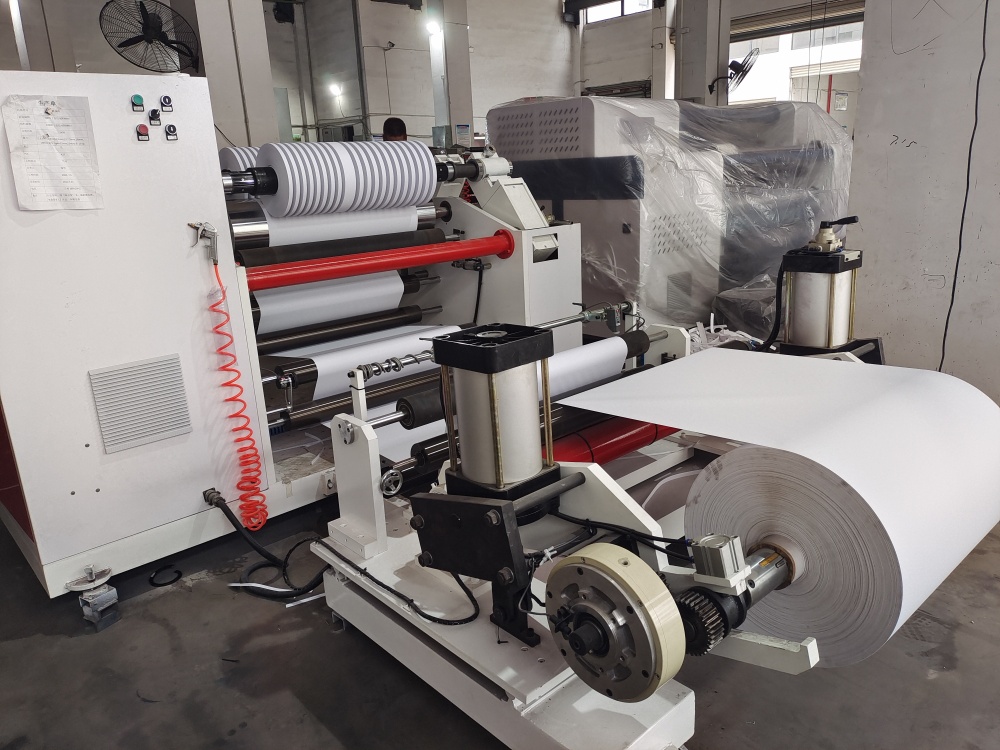
The Anatomy of a High-Performance Slitting Machine
Evaluating a modern Slitting Machine requires examining its three primary zones. Each section must perform flawlessly to ensure premium output quality.
Section 1: Unwinding & Edge Guiding
The unwinding zone dictates how smoothly the material enters the machine. You should evaluate the inclusion of shaftless unwind stands. These mechanisms allow operators to load massive master rolls rapidly without manually inserting heavy steel shafts.
To mitigate alignment risks, look for photoelectric edge guide systems. Industry leaders often specify sensors from brands like E+L. These optical sensors detect real-time material shifting. They then command pneumatic or electric actuators to auto-correct the alignment before the fabric reaches the cutting blades.
Section 2: The Slitting Matrix (Matching Blade to Fabric)
Your choice of cutting technology dictates your final edge integrity. You must match the blade type to your specific substrate.
- Score/Crush Cutting: The machine squeezes the substrate between a dull blade and a hardened steel anvil. This method works very well for heavy wovens and thick composites.
- Razor Slitting: This technique pulls material past a fixed, sharp blade. It remains the best choice for extremely thin substrates like delicate films.
- Hot Knife Slitting: You must use this for uncoated synthetics. The heated blade melts and seals the edge instantly. This crucial step prevents downstream fraying during packaging or sewing.
- Bias Slitting: This specialized module cuts material at a 45-degree angle. It gives woven fabrics artificial stretchability. This stretch is critical for apparel trims to prevent wrinkling and puckering.
Section 3: Rewinding & Tension Control
The rewinding zone determines the structural integrity of the finished rolls. High-end machines utilize turret systems. Turrets allow continuous production by rotating a fresh core into place without stopping the machine line.
Lay-on rollers represent another essential feature. These weighted rollers rest directly against the rewinding material. They actively prevent wrinkles and forcefully squeeze out trapped air as the fabric builds up on the core.
Specialized Solutions: Tubular Knits & Technical Textiles
Standard equipment cannot handle highly specialized materials without causing severe damage. You must seek out targeted engineering solutions for these unique substrates.
Processing Tubular Knits (Rope Opening)
Raw or wet tubular knits present a massive handling challenge. They come from the dye house twisted tightly in a rope-like form. You require careful handling to maintain strict GSM (grams per square meter) and shrinkage parameters.
A capable tubular machine integrates several unique sub-systems. It requires auto-detwisting sensors to identify the fabric's twist direction. Ballooning blowers use compressed air to inflate and open the fabric tube safely. Finally, precise "needle drop" optical sensors detect the exact woven cutting line for highly accurate splitting.
Technical Textiles & Medical Non-Wovens
Products like medical gauze, compression bandages, and surgical mask materials behave differently than standard cotton. They are highly tension-sensitive. Even minor pulling will distort their structural integrity permanently.
You should opt for "centre surface winders" when processing these technical textiles. These specific rewinders support the weight of the roll from the bottom while driving it from the center. They easily handle large diameters of sensitive fabrics. High-performance models achieve minimum slit widths down to 10mm–15mm while maintaining production speeds up to 250m/min.
Common Mistakes to Avoid
- Using crush cut knives on medical non-wovens, which crushes the porous structure.
- Ignoring ambient humidity controls when slicing static-prone technical synthetics.
- Bypassing the edge guide system during fast changeovers to save time.
Substrate Versatility: Scaling from Fabric to Paper and Film
The multi-material reality dominates modern converting floors. Facilities often scale their operations by taking on diverse, highly profitable substrates. An Automatic Paper Slitting Rewinding Machine shares structural core DNA with heavy fabric slitters. However, it requires highly specific adaptations to perform safely and accurately.
Handling Plastics and Films
Friction generates severe heat. Friction from slitting synthetic fabrics, BOPP, or plastic films rapidly causes melting and edge-fusing. Melted edges ruin the roll and destroy downstream printing applications.
When sourcing an Automatic plastic film slitting machine or a heavy-duty BOPP Plastic Roll To Roll Slitting Machine, you must verify the inclusion of active blade cooling systems. The best equipment utilizes liquid coolant loops or sub-zero compressed air jets targeted directly at the friction point.
Handling Paper and Labels
Paper converting introduces a completely different hazard: micro-dust. Airborne paper dust damages optical sensors and contaminates the finished rolls. Therefore, an Automatic paper roll slitting machine requires superior pneumatic dust extraction systems to keep the converting environment pristine.
For narrow web applications, big machines prove highly inefficient. A dedicated Small Slitting Rewinding Machine or a specialized Small roll label slitter machine focuses intensely on footprint efficiency. These compact units prioritize high-precision razor slitting accuracy over heavy-duty crush cutting force.
Automation, Maintenance, and Calculating ROI
A smart purchasing decision looks beyond the initial capital expenditure. Automation significantly improves your operational return on investment by maximizing uptime.
Programmable "Recipe" Systems
Modern machine controllers feature programmable memory banks. These allow operators to save specific tension curves, running speeds, and blade depth configurations for different materials. You simply select a saved "recipe" on the touchscreen. This software completely eliminates wasteful trial-and-error during shift changeovers.
Integrated Blade Maintenance
Dull blades ruin materials instantly. Look for machines outfitted with auto-sharpening systems. High-end models feature dual-motor diamond wheel sharpeners built right into the cutting carriage. These tools allow blades to be maintained in real-time without requiring tedious physical removal.
Safety and Defect Prevention
Operator safety directly impacts your facility's bottom line. Ensure your short-listed equipment includes these non-negotiable features:
- Pneumatic brakes for instantaneous, zero-skid emergency stops.
- Anti-jump roll protection brackets to securely lock heavy master rolls during high-speed runs.
- Static elimination bars to prevent hazardous electrical buildup on synthetic webs.
Shortlisting Logic (Next Steps)
Do not buy converting machinery on specification sheets alone. You should demand a physical sample run from the manufacturer. Send them your actual substrate. When they return the finished rolls, carefully verify the edge sealing quality. Inspect the rewind tension uniformity across the entire roll diameter. If the inner core feels loose while the outer layers feel tight, the tension control system has failed.
Conclusion
The true financial impact of converting equipment is not the initial invoice. The real cost lies in ongoing material waste and excessive downtime caused by poor edge quality or incorrect rewind tension. Choosing between a log slitter and a high-precision rewinder dictates your factory's production capabilities for years.
Before contacting OEMs for quotes, audit your exact material mix. Identify whether you process wovens, delicate knits, paper, or films. Calculate your required minimum slit widths. Determine your maximum master roll weights. Armed with this hard data, you can specify a machine that scales profitably alongside your business growth.
FAQ
Q: What is the difference between a roll slitter and a slitter rewinder?
A: A roll slitter cuts entirely through an unrolled master log all at once, much like a sausage slicer. A slitter rewinder unrolls the material, passes it through precise cutting blades, and rerolls it onto new cores for vastly superior tension control.
Q: How do you prevent synthetic fabrics from fraying during slitting?
A: You must use hot knife slitting modules. These electrically heated blades melt the synthetic fibers as they cut. This action instantly seals the edge in real-time and prevents fraying during downstream handling.
Q: Can a fabric slitter also process plastic film or paper?
A: Yes, provided the machine features the correct adaptations. It needs programmable tension control software, interchangeable razor or shear blade options, and active blade cooling systems to prevent plastic friction melting.
Q: What is the minimum cutting width for an industrial slitting machine?
A: Standard industrial setups typically achieve minimum widths of 25mm to 50mm. However, highly specialized narrow-band machines can cut down to 6mm or 10mm, depending entirely on the structural stability of the fabric.


)