Selecting the wrong cutting equipment for protective films leads to edge melting, burrs, adhesive smearing, and unacceptable material waste. Production managers know these routine failures quickly erode profit margins and frustrate clients. Protective films demand precise tension control and clean separation to maintain their optical and functional integrity. Making the transition from generic cutting tools to specialized equipment becomes absolutely necessary for scaling production. Without the right mechanical approach, handling adhesive layers and sensitive substrates often ends in manufacturing bottlenecks.
This guide provides a practical, vendor-neutral evaluation framework to navigate these choices. We will help production buyers specify the exact machinery required for their unique substrate and volume. Read on to explore how material behavior, throughput needs, and safety standards shape your ideal machinery investment. You will learn to evaluate core features and execute a flawless proof of concept.
Key Takeaways
Material behavior—specifically thermal sensitivity and adhesive backing—dictates whether a laser or physical blade system is viable.
High-volume flat panel protection usually favors a roll to sheet cutter, while complex custom shapes require CNC or laser systems.
Hidden implementation costs include fume extraction (for lasers) and tension-control calibration (for automated feeding).
Never finalize a purchase without a vendor Proof of Concept (PoC) using your exact PET substrate.
1. Defining the Production Baseline: Material and Format Variables
Before evaluating machinery, you must understand your specific material. Polyethylene terephthalate (PET) behaves differently than standard PVC or polyethylene (PE). It possesses exceptionally high tensile strength and a distinct melting point. Generic cutters often struggle to pierce PET cleanly. Operators frequently experience material stretching or microscopic edge tearing if the equipment lacks sufficient downward force or sharp cutting angles.
Substrate Analysis and Adhesive Considerations
The protective film’s adhesive layer significantly impacts the cutting mechanism. Viscosity and thickness determine how the adhesive responds to shear stress. If you use a physical blade, a thick, high-tack adhesive can cause blade gumming. The adhesive builds up on the tool, eventually ruining the cut quality. Conversely, laser systems must vaporize both the PET and the adhesive without burning the edges. Understanding your adhesive chemistry helps prevent these operational roadblocks.
Output Format Requirements
Your end-use application dictates the required output format. Production floors typically divide output into two main categories:
Roll-to-roll slitting: This method takes a master web and slices it into narrower continuous rolls. It requires precise rewind tension.
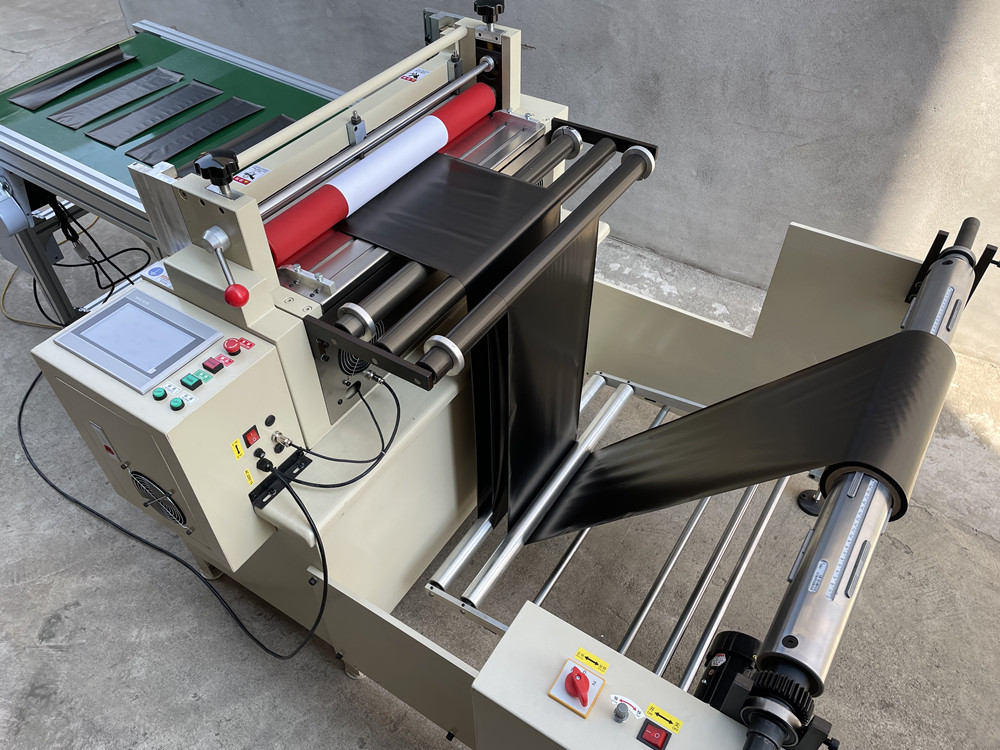
Flat formatting: This involves converting rolls into exact rectangular dimensions. Facilities specializing in this process heavily rely on dedicated PET sheet cutting equipment to maintain tight tolerances across thousands of pieces.
You must also determine your penetration depth. Do you need through-cutting, which severs both the film and its protective liner? Or do you require kiss-cutting, which slices the top film but leaves the underlying release liner completely intact? Kiss-cutting demands extreme Z-axis precision, ruling out lower-tier equipment entirely.
2. Laser vs. Blade: Selecting the Right Technology for Polyester Film
Choosing between physical blades and laser systems is the most critical decision in your equipment journey. Each technology offers distinct advantages and operational risks depending on your volume and geometric complexity.
Blade and Rotary Solutions
The traditional protective film cutter uses rotary shears, crush cut knives, or razor blades. This mechanical approach remains the standard for high-speed, straight-line operations.
Ideal for: High-volume, continuous straight cuts, and handling materials highly sensitive to thermal distortion.
Pros: You get zero edge melting and generate no hazardous fumes. Mechanical cutters offer incredibly fast throughput for simple geometries.
Risks: Blades wear down and require regular replacement. Physical friction can potentially damage high-gloss optical films. As mentioned earlier, adhesive buildup on the blade requires frequent cleaning stops.
Laser Cutting Systems (CO2 / UV)
Laser technology replaces physical friction with focused thermal energy. CO2 lasers are common for plastics, while UV lasers offer cold ablation for ultra-precise micro-cutting.
Ideal for: Intricate custom shapes, rapid prototyping, and short-run production. They serve as excellent die-cut alternatives without expensive tooling costs.
Pros: This is a non-contact process. The machine applies no mechanical stress to the film. The thermal action inherently seals the edge slightly, preventing micro-flaking.
Risks: Lasers create Heat-Affected Zones (HAZ). This localized heating can cause edge yellowing or micro-shrinking. Furthermore, burning polymers requires strict ventilation systems to handle off-gassing.
Technology Comparison Summary
Feature
Blade / Rotary Cutter
Laser System (CO2/UV)
Edge Quality
Clean, sharp, no melting
Slightly sealed, potential HAZ
Operating Speed
Very high (for straight cuts)
Moderate to slow (depends on shape)
Flexibility
Low (requires physical setup)
High (software-driven geometry)
Consumables
Blades, cutting mats
Lenses, laser tubes, assist gas
3. Core Features to Evaluate in a Commercial Polyester Film Cutting Machine
Once you select a core technology, you must evaluate the subsystems governing material handling. An industrial machine is only as good as its feeding mechanism.
Tension Control and Feeding Systems
Protective films stretch easily under improper tension. Therefore, an automatic film cutter must feature a closed-loop tension control system. This setup uses load cells and dancer rollers to monitor web tension in real-time. The controller dynamically adjusts the brake torque on the unwind shaft. This prevents material elongation before the cut. If the film stretches during feeding, it shrinks back after cutting, resulting in pieces that fall short of your specified dimensions.
Precision and Tolerances
You must define your acceptable deviation based on industry standards. For example, automotive display protection requires extreme precision, often demanding tolerances of ±0.1mm. Conversely, basic transit protection films used on construction panels might tolerate ±1.0mm. Ensure the machine’s servomotors and encoders can comfortably hit your target tolerance at full production speed.
Workflow Integration
Modern production environments demand seamless integration. If you are evaluating a dedicated roll to sheet cutter, assess its downstream handling capabilities. Does it feature an auto-stacking conveyor? Does it include static elimination bars? PET generates massive static charges during unwinding, which causes cut sheets to cling together. Active ionizing bars neutralize this charge, enabling neat stacking.
Additionally, evaluate software compatibility. The machine controller should easily accept standard CAD or vector files (like DXF or AI). Quick file conversion reduces changeover times between different product runs.
4. Compliance, Safety, and Operational Efficiency
Industrial machinery introduces specific hazards to your facility. Protecting your workforce and optimizing daily operations are non-negotiable aspects of equipment selection.
Environmental and Safety Guardrails
Safety requirements shift dramatically based on your chosen technology. Laser systems vaporize plastics, generating distinct particulate matter and volatile organic compounds (VOCs). Handling the fumes generated when cutting DTF PET plastics or standard polyester requires industrial-grade extraction systems. You will likely need activated carbon filtration to comply with local environmental regulations.
Physical blade systems pose different risks. High-speed rotary shears and heavy guillotine blades require strict physical safety enclosures. Opt for machines equipped with optical light curtains. If an operator reaches into the active cutting zone, the light curtain instantly breaks the circuit, halting the machine to prevent injury.
Maintenance Realities
Track your expected consumables to understand maintenance downtime. Industrial slitting blades need periodic resharpening or replacement, especially when cutting abrasive hard-coated PET. Monitor how quickly your team can swap a blade cassette. For laser systems, factor in the replacement cycles for focal lenses and CO2 laser tubes, which degrade over thousands of operating hours.
Labor Efficiency
Operational efficiency hinges on human intervention. A basic machine might require constant manual supervision to clear jams or adjust tension. In contrast, advanced systems feature automated fault-detection. They instantly pause and alert operators to web breaks, empty rolls, or servo errors. Investing in intelligent HMI (Human-Machine Interface) touchscreens drastically reduces the learning curve for new operators.
5. The Vendor Shortlisting Framework & Proof of Concept (PoC)
Never rely solely on a vendor's glossy brochure. Sales specifications often reflect ideal conditions using perfectly cooperative materials. Real-world protective films are rarely perfect.
The "Rule of Real Substrates"
You must practice the rule of real substrates. Always send your exact material to the manufacturer for sample testing. Ensure the sample matches your exact thickness, width, and adhesive specifications. Testing a generic PET sample tells you nothing about how the machine will handle your proprietary high-tack silicone adhesive.
PoC Checklist
When the vendor conducts the Proof of Concept, evaluate the results against a strict checklist:
Cycle Times: Measure the actual pieces produced per minute. Does it match the promised specifications?
Edge Inspection: Examine the cut edges under magnification. Look for micro-burrs, thermal shrinkage, or adhesive bleed.
Dimensional Accuracy: Measure the first, fiftieth, and last piece of the test run to verify consistent tolerances.
Waste Generation: Calculate how much edge trim or leader material the machine wastes during setup.
SLA and Support
Finally, evaluate the supplier’s post-purchase infrastructure. A robust Service Level Agreement (SLA) keeps your line running. Ask specific questions about their installation timeline. Do they offer on-site operator training? Verify their local parts availability. Waiting three weeks for a proprietary servo motor to ship internationally will devastate your production schedule.
Conclusion
Choosing the right PET film cutting machine requires careful alignment between your material’s physical properties and your floor’s throughput demands. Adhesives, thermal limits, and static generation all dictate the mechanical necessities of your equipment. Whether you opt for a mechanical shear or a laser system, prioritizing closed-loop tension control and safety compliance ensures long-term operational success.
Your next step is to formalize your requirements. Document your exact film specifications, including thickness, master roll width, and adhesive type. Determine your minimum viable throughput in pieces or meters per minute. Armed with this data, you can confidently approach vendors and demand a rigorous Proof of Concept on a specialized polyester film cutting machine. Taking these precise actions will secure an investment that scales profitably with your business.
FAQ
Q: Can a standard vinyl cutter be used for PET protective films?
A: Generally no. PET possesses a much higher tensile strength than standard vinyl. Standard cutters lack the necessary downward force, resulting in incomplete cuts. Furthermore, the specialized adhesives on protective films often cause gumming on standard blades. Specialized blade angles and higher-pressure carriage systems are required to process PET cleanly.
Q: Does laser cutting PET film leave burnt edges?
A: It depends heavily on machine calibration. Proper power-to-speed ratios and the use of compressed assist-gas can significantly minimize the Heat-Affected Zone (HAZ). However, slight edge melting is inherent to the thermal ablation process. While UV lasers reduce this effect compared to CO2 lasers, some edge sealing always occurs.
Q: What is the advantage of a roll-to-sheet cutter over manual sizing?
A: An automated roll to sheet cutter exponentially reduces labor costs and eliminates human-error dimensional variance. It processes large master rolls into precise flat sheets rapidly. Furthermore, these machines integrate essential secondary processes—like de-curling mechanisms and active anti-static treatments—in a single continuous pass, improving overall product quality.



)