Edge trim is not an inevitable byproduct of film converting. You should view it as a measurable, controllable variable that directly impacts your gross margins and overall equipment effectiveness. Micro-inefficiencies in web handling, tension control, and blade alignment compound rapidly over high-speed runs. These small errors result in excessive scrap rates, increase disposal overhead, and reduce your master roll yield. When you run thousands of meters of material per shift, a few millimeters of unnecessary trim quickly add up to massive material losses.
Minimizing this waste requires a systematic approach rather than relying on operator guesswork. Floor personnel must optimize hardware settings and apply substrate-specific configurations based on the exact material properties. Evaluating modern slitting technology upgrades also plays a major role in tightening tolerances. By addressing these mechanical and operational factors, you can narrow your trim margins safely without risking web breaks or poor roll profiles. This guide breaks down the technical steps to maximize usable web width and recover lost revenue on the converting floor.
Key Takeaways
Precision Web Guiding is Non-Negotiable: Advanced edge and line guiding systems are the primary defense against lateral wander, allowing operators to safely reduce trim margins to bare minimums.
Tension Control Dictates Yield: Inconsistent tension across unwind, slitting, and rewind zones causes material stretching and telescoping, forcing wider edge trim allowances.
Substrate-Specific Configurations Matter: BOPP, PET, and PVC require distinct blade types, shaft rigidities, and tension profiles to prevent edge deformation and micro-tearing.
Trim Handling Can Bottleneck Efficiency: Inefficient trim extraction systems limit the operational speed of the film slitter rewinder; integrated evacuation and granulation are vital for continuous high-speed runs.
Input Material Quality Limits Minimization: Out-of-tolerance incoming master rolls (e.g., uneven winding or edge weaving) set a high baseline for unavoidable waste before the slitting process even begins.
The Economics of Slitting Edge Waste in Film Converting
Defining acceptable waste margins is your first operational step. High-volume operations often accept historical scrap rates without question, assuming the machines are running as efficiently as possible. You must establish a new baseline. The primary goal is maximizing the usable width of every master roll. Even minor reductions in trim width yield massive annual savings when calculated across multiple shifts and machines.
Cost Analysis
Understanding the hidden costs of edge waste requires tracking multiple variables. It is not just about lost plastic. You must account for machine time, energy consumption, and disposal overhead. The formula below illustrates the true cost of excess trim: Total Cost = Material Cost + Machine Operating Time + Disposal/Recycling Overhead - Scrap Value.
Cost Variable
Impact on Operation
Calculation Factor
Material Cost
Direct loss of sellable substrate.
Trim width × run length × material price per kg
Machine Operating Time
Time spent slitting material that ends up in the bin.
Machine hourly rate × percentage of waste
Disposal/Recycling Overhead
Labor and energy used to extract, transport, or granulate trim.
Energy + labor costs for waste handling
Scrap Value
Revenue recovered if trim is sold or re-extruded.
(Subtract this from total costs)
The Compounding Effect
Reducing edge trim by just two or three millimeters seems insignificant on a single roll. However, high-speed runs amplify this reduction. Over a year, saving three millimeters on a high-volume line translates to thousands of kilograms of recovered material. This directly recovers profit margins. You spend less on raw materials and generate more sellable product. For example, running a 1500mm web at 400 meters per minute for two shifts a day means a 2mm reduction saves roughly 768 square meters of film daily.
The Master Roll Quality Variable
Incoming master roll quality dictates your minimum waste baseline. Variation in the roll profile forces operators to compensate. Telescoping, gauge variation, and uneven winding require wider trim margins. If the master roll weaves by five millimeters, you cannot set a three-millimeter trim. You must address supplier quality to push slitting edge waste to its absolute minimum. Inspect incoming rolls for gauge bands and soft edges before loading them onto the unwind stand.
Core Hardware Capabilities of a High-Efficiency Plastic Film Slitting Machine
You cannot optimize a process if the hardware lacks precision. The critical components of a plastic film slitting machine directly influence waste reduction. We must evaluate these features based on their operational outcomes and mechanical stability.
Automated Web Guiding and Substrate Feed Alignment
Web guiding systems keep the material running true. Ultrasonic and optical sensors detect the edge position on various film backings. Ultrasonic sensors work well for clear films where optical sensors might fail due to transparency. Optical sensors excel with opaque, metallized, or heavily printed substrates where contrast is high.
Closed-loop feedback systems correct lateral movement in real-time. The sensor detects a shift and signals the actuator. The actuator adjusts the unwind stand or guide rollers instantly. This continuous correction enables tighter trim tolerances. Operators no longer need large safety margins to prevent unslit edges. A high-quality edge guide should hold the web position within +/- 0.1mm at full production speed.
Multi-Zone Tension Control Systems
Independent tension zones are mandatory within the film slitter rewinder. You need separate control for the unwind, draw, and rewind sections. Material behaves differently in each zone as it passes over idler rollers and through the nip points.
Load cells and dancer rollers measure and adjust web tension dynamically. They prevent material elongation and wrinkling. If tension drops, the film sags and wanders. If tension spikes, the film stretches. Both scenarios force operators to trim wider edges to remove deformed material. Precise multi-zone control eliminates this requirement, keeping the web flat and stable as it hits the knives.
Blade Shaft Rigidity and Anti-Vibration Structures
The mechanical engineering of the blade shaft support structure dictates cut quality. Any flex in the shaft causes the blades to wander. This creates wavy edges and out-of-tolerance rolls. Shaft deflection is a common issue on wider machines running thick materials.
Heavy-duty cast frame structures absorb operational frequencies better than welded steel plates. Anti-vibration engineering prevents blade oscillation at high speeds. Stable blades ensure clean cuts. Clean cuts prevent edge fraying and micro-tearing. When edges are clean, you reject fewer rolls and minimize trim width. Ensure your bottom knife shaft is dynamically balanced to handle maximum RPM without inducing chatter.
Optimizing Setup for Specific Substrates
A one-size-fits-all approach guarantees high scrap rates. Different polymers require distinct handling techniques. You must address the technical nuances of your specific substrate to maintain edge integrity.
BOPP Film Slitting Machine Configurations
Biaxially-oriented polypropylene has high tensile strength and stiffness. A dedicated BOPP film slitting machine must handle these characteristics without fracturing the web or causing the slit rolls to interleave.
Blade selection depends on micron thickness. Razor slitting works well for thinner BOPP films, typically under 30 microns. Shear slitting is necessary for thicker gauges to prevent the blade from wandering. Precise blade angles are critical. Incorrect angles cause edge cracking, which forces you to increase the trim allowance to reach clean material. Set the razor angle between 45 and 60 degrees relative to the web path for optimal slicing action.
PET Film Slitter Requirements
PET generates significant static electricity. It also suffers from minor thickness variations across the web profile. Operating a PET film slitter demands strict static control and heavy-duty cutting components.
Active static elimination bars are necessary. They neutralize the web before and after the cutting zone. You also need robust shear slitting setups. Shear blades maintain edge integrity without generating dust or micro-fractures. Dust accumulation ruins roll quality and increases waste, especially in cleanroom environments. Ensure the top and bottom shear blades have the correct overspeed ratio, usually setting the bottom knife 3% to 5% faster than the web speed.
PVC Film Slitting Challenges
PVC presents unique challenges due to its elasticity and thermal sensitivity. It is often tacky and stretches easily under tension. Proper PVC film slitting involves managing these physical traits carefully to prevent the material from necking down before the cut.
Specialized tension profiles prevent material stretching. You must run PVC at lower tensions than PET or BOPP. Temperature-controlled environments are also beneficial. They prevent the film from softening and curling at the edges during the slitting process. Use plasma-coated or grooved idler rollers to reduce the contact area and prevent the tacky PVC from sticking and wrapping around the rollers.
Substrate
Primary Challenge
Recommended Slitting Method
Tension Requirement
BOPP
High stiffness, prone to edge cracking
Razor (thin) / Shear (thick)
Medium-High
PET
Static generation, dust accumulation
Shear slitting only
High
PVC
Elasticity, tackiness, thermal sensitivity
Shear or Score slitting
Low-Medium
Operational Frameworks to Minimize Trim Waste
Hardware alone cannot eliminate waste. Operator-driven process optimizations are equally important. You must implement strict operational frameworks on the floor to maintain consistency across shifts.
Width Optimization and Master Roll Utilization
You must calculate optimal slit widths before loading the master roll. Mathematical modeling helps maximize total width utilization. Software tools calculate the best combination of finished roll widths. This minimizes the leftover edge trim on the master roll. Planning the cut layout digitally prevents unnecessary physical waste. If you have a 1600mm master roll and need 300mm finished rolls, running five cuts leaves 100mm of waste. Software can help mix orders to utilize that remaining 100mm efficiently.
Blade Management: Selection, Sharpness, and Alignment
Establish strict protocols for blade lifecycle management. Do not wait for blades to fail before replacing them. Dull blades cause micro-fractures and stretching.
When edges stretch, operators increase the trim width to guarantee a clean, sellable edge. Regular inspection and replacement schedules prevent this. Proper alignment is also crucial. Misaligned shear blades create burrs and dust, ruining the roll edge. Implement a standardized gauge tool for operators to set the exact cant angle and overlap for shear knives every time they change a setup.
Environmental Control and Machine Cleanliness
Ambient conditions impact web stability. Temperature and humidity fluctuations change film properties. Airborne dust settles on rollers and alters friction coefficients.
Maintain strict cleaning protocols. Keep idler rollers free of adhesives and contaminants. Dirty rollers cause micro-slippage. Slippage disrupts tension, causing the web to wander. A clean machine ensures consistent tracking and minimal edge trim. Wipe down all nip rollers with approved solvents at the end of every shift to maintain their durometer and grip.
Operator Training and Standardized Setup Protocols
Operator variation leads to inconsistent scrap rates. One operator might set a five-millimeter trim, while another sets eight millimeters for the same job just to be safe.
Standardize knife positioning and tension settings. Modern PLC systems offer digital recipe management. Use these features to save job parameters. This eliminates human error during changeovers. Standardized setups ensure every shift runs with the tightest possible trim margins. Train operators to trust the digital readouts rather than relying on manual tape measures and visual estimates.
Evaluating Film Slitter Rewinder Upgrades vs. Process Optimization
You will eventually face a choice. Do you refine your current operations, or do you invest in new equipment? You need a decision framework for capital expenditure versus operational refinement to justify the budget.
When to Retrofit Existing Equipment
Retrofitting offers a strong ROI in specific scenarios. Upgrading a legacy pneumatic brake to a servo-driven tension control system improves web stability. Installing a modern digital web guide reduces lateral wander significantly.
However, retrofitting carries implementation risks. You may face compatibility issues with legacy PLC systems. Downtime during installation disrupts production. Furthermore, if the machine frame lacks rigidity, vibration issues will persist despite new sensors and controls. Evaluate the mechanical soundness of the side frames and bearings before spending money on electronic upgrades.
When to Invest in a New Machine
There is a tipping point where legacy equipment prevents further waste reduction. If the frame flexes or the control systems cannot process closed-loop feedback fast enough, you need new hardware.
Modern machines feature automated knife positioning systems. They utilize advanced closed-loop digital controls. These features drastically reduce setup waste and allow for razor-thin edge trim. The material savings often justify the ROI of a new machine within a few years. When evaluating new equipment, look for direct-drive servo motors that eliminate the backlash found in older belt-driven systems.
Assess current waste percentages over a 30-day production period.
Identify if the waste is caused by web wander, poor tension, or dull blades.
Quote the cost of retrofitting a new web guide and tension controller.
Compare the retrofit cost against the down payment and efficiency gains of a new machine.
Calculate the payback period based on material savings alone.
Edge Trim Handling and Recycling Integration
You cannot eliminate all edge waste. You must manage the remaining trim efficiently. Scalability and compliance depend on proper waste handling systems that do not interfere with the main web.
Overcoming the Trim Handling Bottleneck
Inadequate trim removal systems limit your operational speed. If the extraction fan cannot keep up, the trim breaks. The machine stops, and you lose production time. This creates an artificial capacity ceiling for your slitting line. Operators will slow the machine down just to keep the trim from snapping, which destroys your OEE metrics.
In-line Trim Removal Systems
Evaluate pneumatic trim extraction systems. Venturis, injectors, and rotary choppers remove edge waste continuously. They do this without limiting machine speed. Crucially, a properly designed extraction system pulls the trim without causing tension spikes on the main web edge. Ensure the ducting has smooth radius bends to prevent the continuous trim from snagging and backing up into the slitter.
Closing the Loop: Granulation and Reprocessing
Integrate granulators directly into the extraction line. These units immediately process continuous edge trim into uniform regrind. High-density regrind is ready for re-extrusion. This closed-loop approach minimizes material loss and turns unavoidable trim back into usable raw material. Position the granulator in a soundproof enclosure to maintain a safe decibel level on the production floor.
Conclusion
Reducing edge waste requires a holistic approach. You must combine rigid machine architecture, precise web guiding, and substrate-specific tension control. Hardware and operational protocols must work together to maximize master roll yield and keep your converting lines profitable.
When evaluating new equipment, prioritize vendors who demonstrate tight tolerance capabilities. Look for robust anti-vibration engineering. Demand live material trials to verify integrated trim handling systems before signing any purchase orders.
Take these immediate next steps to improve your operations:
Conduct a comprehensive waste audit on all current slitting lines to establish a baseline.
Standardize blade management and setup recipes across all operator shifts using digital PLC controls.
Consult with specialized equipment manufacturers to identify targeted hardware upgrades for your specific substrates.
FAQ
Q: What is the acceptable edge trim width for a standard plastic film slitting machine?
A: Industry standards typically range from 5mm to 15mm per side. This depends on the substrate, machine age, and web guiding capabilities. State-of-the-art machines with closed-loop guiding can run margins as narrow as 2-3mm safely.
Q: How does tension control affect slitting edge waste?
A: Poor tension causes material wander, wrinkling, and stretching. This forces operators to increase the trim allowance. Proper tension ensures final slit rolls have clean, uniform edges without interleaving or telescoping.
Q: Can a BOPP film slitting machine be used for PVC film?
A: Mechanically, it is possible on versatile slitter rewinders. However, PVC's high elasticity and thermal sensitivity require vastly different tension profiles and blade setups than rigid BOPP. You must recalibrate the machine carefully to avoid high scrap rates.
Q: What is the best cutting method for a PET film slitter?
A: Shear slitting is the optimal method for PET. It ensures clean edges and minimizes static-bound dust generation. This clean cut is critical for medical, optical, and electronics packaging applications.
Q: How do automated knife positioning systems reduce waste?
A: Automated systems eliminate human error in manual blade setup. They ensure exact width measurements. This drastically reduces setup time and the associated test-run waste generated during manual adjustments.
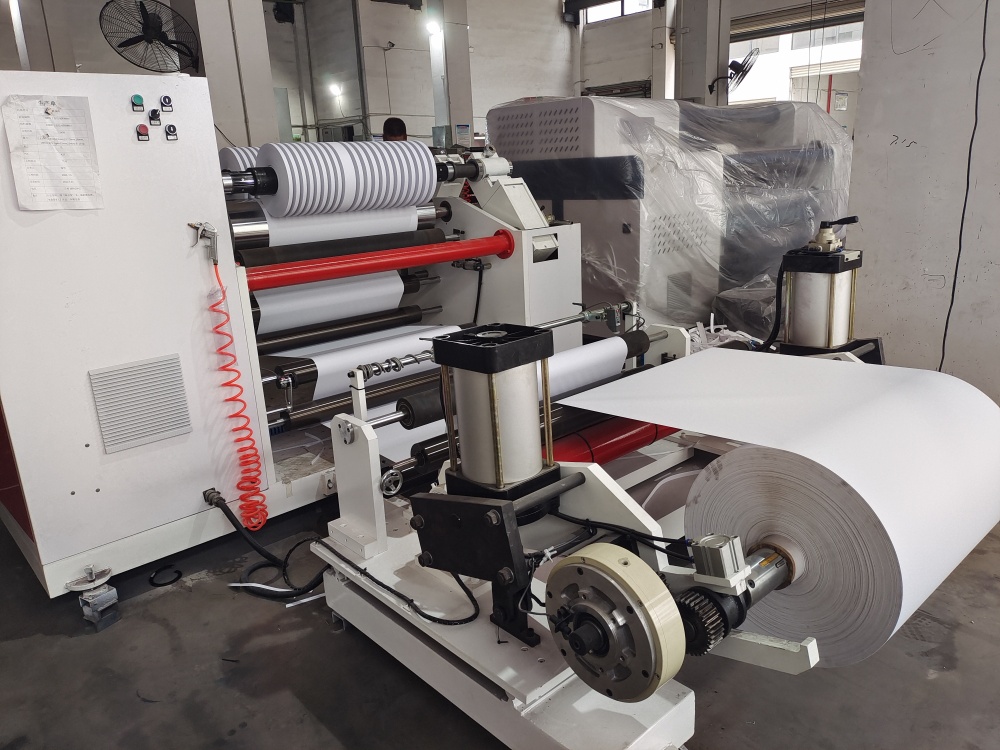
Q: What is a film slitter rewinder?
A: It is the complete machine system that unwinds a master roll, slits it into narrower widths, and rewinds it onto new cores. It plays a central role in the flexible packaging and converting process.
Q: How can I recycle slitting edge waste efficiently?
A: Recommend using in-line pneumatic extraction combined with a granulator. This system immediately chops the continuous trim into uniform regrind, making it ready for the extrusion process without secondary handling.



)