You want an automatic slitting machine that matches your industry, materials, and production needs. In 2026, many manufacturers focus on automation to boost efficiency and cut labor costs. The automatic slitting machine must handle your material type, production scale, and quality targets. Check the table below to see the adoption rate of automation in slitting machines:
Trend | Description | Impact | Adoption Rate (%) |
Automation | Increased automation in slitting machines for improved efficiency and reduced labor costs. | Higher production rates and lower human error. | 75 |
You secure your investment when you choose an automatic slitting machine that fits both current and future demands. Consider machine performance, automation level, cost, and vendor support before you decide on an automatic slitting machine. The right automatic slitting machine will keep you competitive.
Key Takeaways
Identify your material type and specifications before selecting a slitting machine. This ensures compatibility and optimal performance.
Assess your production volume needs. Choose a machine that can handle your required throughput efficiently.
Focus on precision and slit quality. High cutting accuracy reduces waste and improves product quality.
Consider automation features. Advanced controls can boost productivity and reduce labor costs significantly.
Evaluate the total cost of ownership. Look beyond the purchase price to include maintenance, energy use, and potential upgrades.
Ensure strong vendor support. Reliable service and training are crucial for maintaining machine efficiency and performance.
Check for safety and environmental compliance. Meeting industry standards protects your workers and your business.
Plan for future upgrades. Choose machines with modular designs to adapt to changing production needs.
Define Your Needs for Automatic Slitting Machine
Choosing the right automatic slitting machine starts with understanding your requirements. You need to match the machine to your slitting material, production efficiency goals, and quality expectations. Begin by clarifying the material type and specifications.
Material Compatibility and Specs
You must identify the material you plan to process. Automatic slitting machines handle a variety of materials in industrial applications:
Paper: Used in printing and packaging for smaller rolls.
Film: Essential for packaging materials and labels.
Foil: Common in food and pharmaceutical packaging.
Metal: Important for producing strips in manufacturing.
Thickness and Width
You should check the material thickness range and width. These requirements affect the machine’s shaft configuration and size. If you process thin film or thick metal, you need a machine that supports your specifications. The slitting width and diameter also influence the choice. Machines with adjustable settings help you meet changing requirements.
Special Handling
Some materials require special handling. Fragile film or delicate foil may need tension control or anti-static features. You must consider these requirements to protect quality and avoid waste. If you work with composite materials, you may need advanced slitting methods.
Production Volume
You must assess your production volume. Decide if you need batch processing or continuous operation. Large production capacity demands machines with high production efficiency. Machines with faster slitting speed and stable operation help you meet tight deadlines. Production speed impacts dynamic accuracy and stability. You should select a machine that matches your requirements for throughput.
Quality Standards
Quality is critical in every industry. You must define your requirements for slit quality, edge finish, and repeatability. Machines with online inspection and automatic unloading improve quality and reduce errors. If your industry requires strict standards, you need a machine that delivers consistent results. High-quality slitting ensures customer satisfaction and reduces rework.
Tip: Create a checklist of your requirements before you contact vendors. This helps you compare machines and find the best fit for your production efficiency and quality goals.
You must align your requirements with the machine’s features. Consider material type, thickness, width, special handling, production volume, and quality standards. This step ensures you select an automatic slitting machine that supports your business growth.
Slitting Machine Selection Guide: Key Features
Precision and Slit Quality
You need to focus on precision and cutting quality when you select an automatic slitting machine. High cutting accuracy ensures your materials fit perfectly in downstream processes. If you want to reduce waste and improve your product’s appearance, you must choose a machine that delivers consistent precision.
Key performance metrics for precision and slit quality include:
Cutting accuracy: This keeps your slits straight and uniform.
Precision: This helps you achieve tight tolerances for demanding applications.
Slitting speed: This shows how many labels or strips you can process in a set time.
Downtime: This measures how often your machine stops, which affects your overall performance.
Precision in slitting tools gives you tighter tolerances. You get less material waste and better efficiency. High-quality slitting also improves material handling, which keeps your costs down. When you maintain tight tolerances, you avoid overprocessing and keep your production streamlined. Clean edges from accurate slitting reduce tooling wear and help your fabricators work faster.
Precision slitting is essential for OEMs. It helps you meet waste reduction goals and optimize your supply chain. You can turn large coils into narrow strips that are ready for the next step. This supports just-in-time delivery and lean manufacturing.
Note: Cutting accuracy and slit quality directly impact your reputation. Customers expect clean, uniform products. Poor slit quality can lead to rework and lost business.
Speed and Throughput
You must consider speed and throughput when you evaluate slitting machines. High throughput means you can process more material in less time. This boosts your productivity and helps you meet tight deadlines.
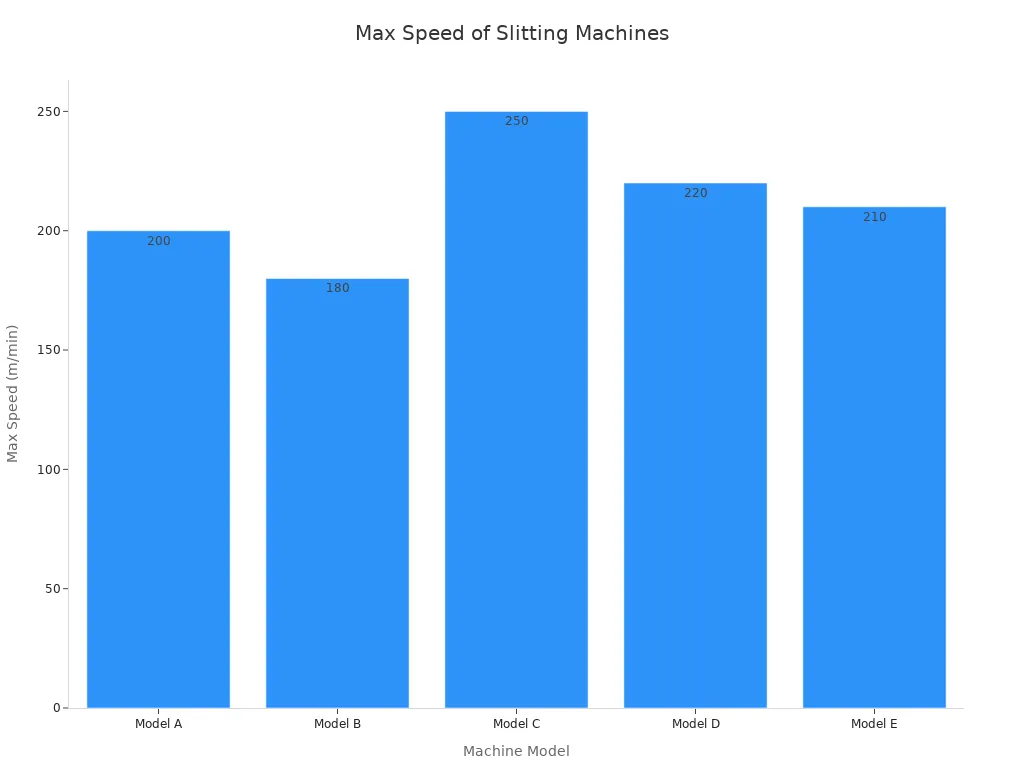
Modern automatic slitting machines offer impressive speeds. The table below compares the maximum speed of several models available in 2026:
Model | Max Speed (m/min) |
Model A | 200 |
Model B | 180 |
Model C | 250 |
Model D | 220 |
Model E | 210 |
When you choose a machine, look for one that matches your production targets. High speed and stable operation help you keep up with demand. Cutting accuracy at high speed is also important. If your machine loses precision at top speed, you may face quality issues.
Tip: Balance speed and cutting accuracy. A faster machine is not always better if it cannot maintain precision.
Automation and Controls
Automation and integration play a big role in modern slitting machine selection. Advanced controls let you automate setup, tension control, and even inspection. Higher automation levels can reduce your labor costs by up to 30%. You also get a productivity boost of up to 30% with advanced technology.
With automated controls, you can:
Set up jobs quickly with minimal manual input.
Monitor cutting accuracy in real time.
Reduce errors and improve repeatability.
Track performance data for continuous improvement.
You should look for machines with user-friendly interfaces and smart sensors. These features help you maintain high performance and adapt to changing production needs. Automation also supports remote monitoring and predictive maintenance, which reduces downtime.
Callout: Automation and integration prepare your operation for Industry 4.0. You can connect your slitting machine to other systems for better data flow and efficiency.
The slitting machine selection guide shows that you must focus on precision, speed, and automation. These features help you achieve high cutting accuracy, boost throughput, and stay competitive in 2026.
Blade Types and Surface Finish
You must pay close attention to blade selection when you choose an automatic slitting machine. The blade type directly affects the quality of your cuts, the surface finish, and the lifespan of your equipment. Each material and application requires a specific blade to achieve the best results.
The table below shows common blade types and their key features:
Blade Type | Description |
High Carbon Tool Steel | Offers excellent sharpness retention for general cuts. |
Stainless Steel | Necessary for applications where corrosion is a risk. |
Tungsten Carbide | Ideal for extreme durability, especially with abrasive materials. |
Ceramic | Used in special applications for heat resistance and non-magnetic properties. |
TiN/TiCN Coatings | Boost surface hardness, increasing durability and edge life. |
Zero-Friction Coatings | Essential for sticky materials, preventing buildup. |
Thickness and Bevel Angle | Affects cut quality; sharper angles cut cleaner but are more fragile. |
Single vs. Double Bevel | Double bevels are stronger; single bevels allow for precise edge control. |
Edge Finish | Critical for minimal burrs and dusting, can be polished for high-quality cuts. |
You should match the blade material to your slitting application. High carbon tool steel blades work well for most general cuts. Stainless steel blades resist corrosion, which is important for slitting food packaging or medical materials. Tungsten carbide blades last longer and handle abrasive materials without wearing down quickly. Ceramic blades resist heat and do not attract magnetic particles, making them useful for special environments.
Coatings also play a big role. TiN or TiCN coatings increase surface hardness and extend blade life. Zero-friction coatings help when you process sticky films or adhesives. These coatings prevent material from building up on the blade, which keeps your cuts clean.
Blade geometry matters, too. Thinner blades with sharper bevel angles produce cleaner cuts but may break more easily. Double bevel blades give you more strength, while single bevel blades offer better control for precise edges. You should consider the edge finish as well. Polished edges reduce burrs and dust, which improves the quality of your final product.
Tip: Always check the compatibility of your blade with your material. The right blade reduces downtime, lowers maintenance costs, and improves repeatability.
A good surface finish means fewer defects and less rework. You get smoother edges, which helps in downstream processes like laminating or printing. When you select the right blade and maintain it properly, you increase your machine’s productivity and keep your customers satisfied.
If you need help choosing the best blade for your material, consult with experts from Longterm Machinery. They can recommend the right configuration for your production line.
Cost and Ownership Considerations
When you choose an automatic slitting machine, you must look beyond the purchase price. You need to understand all the costs that come with ownership. These costs affect your budget and your ability to maintain high efficiency in your production line.
Initial vs. Long-Term Costs
You may see a low price tag on some slitting machines. However, the initial cost is only one part of the total investment. You must consider long-term costs as well. These include maintenance, spare parts, energy use, and possible upgrades. Machines with advanced key configuration requirements may cost more at first, but they often deliver better efficiency and lower operating costs over time.
You should compare the total cost of ownership for each machine. Look at the price of the machine, the cost of installation, and the expenses for training your team. Some machines require special tools or software. These add to your long-term costs. When you plan for the future, you protect your investment and avoid surprises.
Tip: Ask vendors for a breakdown of all costs, not just the purchase price. This helps you make a smart decision based on clear criteria.
Energy and Maintenance
Energy use is a major factor in the cost of running a slitting machine. Machines with high efficiency motors and smart controls use less power. This lowers your energy bills and supports your sustainability goals. You should check the energy rating and see if the machine meets your key configuration requirements for efficiency.
Maintenance also plays a big role in ownership costs. Machines with easy-to-replace parts and clear maintenance schedules save you time and money. You should look for slitting machines that offer simple access to blades and rollers. This reduces downtime and keeps your line running smoothly. Regular maintenance helps you avoid costly repairs and extends the life of your equipment.
Note: High efficiency in both energy use and maintenance means you spend less over the life of your machine.
Downtime and Spare Parts
Downtime can hurt your production schedule and your profits. You need to keep your slitting machine running as much as possible. The availability of spare parts is crucial for minimizing downtime. When you have spare parts on hand, you can fix problems quickly and get back to work. This boosts your operational efficiency.
Having spare parts ready reduces the time your machine is out of service.
Quick access to parts supports your key configuration requirements for fast recovery.
Reliable spare parts supply helps you meet your production criteria.
You should ask your vendor about spare parts support. Longterm Machinery offers strong after-sales service and can help you keep your slitting machine in top shape. Make sure you include spare parts availability in your list of key configuration requirements.
Callout: A good spare parts plan keeps your slitting line running and protects your bottom line.
When you consider all these factors, you make a smart choice. You get a slitting machine that meets your criteria for cost, efficiency, and reliability.
Vendor Support and Service
Choosing the right automatic slitting machine involves more than just technical specifications and configuration. You need strong vendor support to keep your production line running smoothly. Reliable service ensures you get the most from your investment and maintain high efficiency.
Technical Support
You benefit from technical support that covers installation, commissioning, and ongoing assistance. Top vendors provide after-sales support to help you solve operational issues quickly. You can rely on a professional service team that responds fast to your needs. This support helps you maintain your machine’s configuration and avoid costly downtime.
Service Type | Description |
After-sales service | Comprehensive support including installation, commissioning, training, and technical assistance. |
Response capability | Professional service team available to quickly address customer needs and operational issues. |
Training | On-site training for operators to ensure efficient machine operation. |
You also get access to spare parts, which keeps your machine running and supports your configuration requirements. When you choose Longterm Machinery, you receive technical support that matches your production goals and ensures ease of operation and maintenance.
Tip: Ask about the vendor’s response time and spare parts availability. Quick support keeps your production on schedule.
Training and Warranty
You need training programs that teach your team how to operate and maintain the machine. Vendors offer both theoretical and hands-on instruction. Skilled technicians help with installation and setup, making sure your machine’s configuration meets your needs.
Feature | Details |
Technical Support | Professional product training and operation guidance, including on-site maintenance and remote services. |
After-sale Support | 24/7 online services with timely responses. One-year warranty on core components (excluding consumables) and lifetime maintenance service for all products. |
Installation Support | Skilled technicians provide prompt installation and setup services. |
Training Programs | Comprehensive training includes theoretical and hands-on instruction for machine operation and maintenance. |
Technical Support | 24/7 availability for addressing concerns and providing remote diagnostics. |
You receive a one-year warranty on core components, which protects your investment. Lifetime maintenance service ensures your machine stays in top condition. With Longterm Machinery, you get support that covers every aspect of configuration, from installation to ongoing maintenance.
Note: Training and warranty packages help you maximize productivity and reduce risks. Well-trained operators keep your machine’s configuration optimized.
Longterm Machinery Advantages
Longterm Machinery offers several advantages over entry-level models. You gain improved efficiency and accuracy, which supports your configuration requirements. You can handle a wider range of materials and maintain consistent quality across large production runs. Reduced labor costs and reliable performance make Longterm Machinery a smart choice for future-ready operations.
Improved efficiency and accuracy
Reduced labor costs
Ability to handle a wider range of materials
Consistent quality across large production runs
You also benefit from advanced configuration options that adapt to your changing needs. Longterm Machinery’s support team helps you upgrade your configuration as your business grows. You get machines designed for ease of operation and maintenance, which keeps your production line running smoothly.
Callout: Longterm Machinery provides strong vendor support, advanced configuration, and reliable service. You secure your investment and stay competitive in 2026.
Choose the Right Model for Your Material
Paper and Film
You need a slitting machine that handles paper and film with speed and precision. These materials require careful control to avoid tearing or wrinkling. When you process paper or thin films, you must look for machines with adjustable tension and high-speed operation. Longterm Machinery offers models that fit these needs.
The High Speed Automatic Slitter Rewinder stands out for paper and film applications. You can see its features in the table below:
Feature | Details |
Model | High Speed Automatic Slitter Rewinder |
Suitable Materials | 10-250um Film, Paper, Non-Woven, Foil |
Slitting Speed | Max 450m/Min |
Roll Material Width | 380-1350mm |
Slitting Width | 25-1300mm |
Power | 11kw |
Dimension (LWH) | 420022001800mm |
Weight | 4100kg |
Certification | SGS, CE |
You get fast slitting speeds and wide compatibility. The machine supports both small and large rolls. You can adjust the slitting width to match your production needs. Certifications like SGS and CE show that the machine meets safety and quality standards.
Tip: Choose a model with tension control and automatic alignment. This helps you reduce waste and improve roll quality.
Metals and Foils
You must select a machine that handles metals and foils with high accuracy. These materials often require ultra-sensitive tension control and advanced blade technology. Longterm Machinery provides several models for metals and foils. You can compare their features in the table below:
Machine Model | Slitting Speed | Min. Slitting Width | Unwinding Diameter | Rewinding Diameter |
QFJ-B500 | 500/min | 20mm | Φ 750mm (Customizable) | Φ 450mm (Customizable) |
QFJ-C200 | 200/min | 10mm | Φ 1000mm (Customizable) | Φ 600mm (Customizable) |
QFJ-C500 | 500/min | 20mm | Φ 1000mm (Customizable) | Φ 600mm (Customizable) |
You benefit from precision and high-speed operation. These machines use diamond-coated blades for clean cuts. AI-powered edge detection helps you adjust blades for accurate results. Ultra-low tension capability prevents breakage of thin foils. The high-precision slitting system keeps accuracy within ±0.5mm. Differential shafts improve rewinding and reduce wrinkles.
This type of machine has proven success in the lithium-ion battery industry. You can rely on it for high-volume production of metal foils.
Note: Look for models with customizable unwinding and rewinding diameters. This lets you match the machine to your material rolls.
Textiles and Nonwovens
You need special features when you process textiles and nonwovens. These materials can stretch or fray easily. Precision cutting is essential to minimize waste. Advanced slitting mechanisms, such as wrap shear slitting and pneumatic cutters, help you achieve accurate widths.
You should use machines with quality control systems. These systems monitor the slitting process and ensure consistent results. You get fewer defects and less material waste.
Precision cutting gives you accurate widths.
Advanced slitting mechanisms improve accuracy.
Quality control systems reduce defects.
Callout: Choose the right model with wrap shear slitting and real-time quality monitoring. This helps you keep your production efficient and your material waste low.
You can find machines from Longterm Machinery that offer these features. You improve your output and maintain high standards for textiles and nonwovens.
Custom Solutions
You may find that standard slitting machines do not meet every production challenge. Some industries have unique requirements that demand custom solutions. You can work with Longterm Machinery to develop a machine that fits your exact needs.
Custom solutions become essential when you face special production environments or strict quality standards. For example, medical labeling requires sterile conditions and high accuracy. Electronic component manufacturing needs machines that operate in clean environments. Outdoor label production must avoid damage to coatings during slitting. Flexible production lines need to switch quickly between different specifications.
Here are some situations where you may need a custom slitting solution:
Medical labeling: You need sterile environments and precise slitting for safety and compliance.
Electronic components: You must maintain strict cleanliness to prevent contamination.
Outdoor labels: You want to protect coatings and finishes from scratches or damage.
Flexible production: You require machines that switch quickly between sizes and materials.
Tip: Custom machines help you solve problems that standard models cannot address. You get better results and higher efficiency.
When you choose a custom solution, you gain access to advanced technical features. Longterm Machinery can integrate these key elements into your slitting machine:
Precision slitting systems: Achieve accuracy up to ±0.1mm for demanding applications.
Intelligent tension control: Maintain stable tension for a wide range of materials.
Clean production environments: Use air purification systems to meet sensitive industry standards.
Flexible configurations: Change settings quickly to match new production needs.
Intelligent testing: Monitor quality in real time with smart sensors and automated checks.
You can request features that match your workflow. For example, you may want a machine that handles both wide and narrow rolls. You may need special blade materials or coatings for sticky or abrasive products. You can also ask for automated job changeovers to reduce downtime.
Note: Custom solutions often include remote monitoring and data tracking. These features help you improve quality and trace production issues.
Longterm Machinery works with you to design, build, and support your custom slitting machine. You receive training and technical support to keep your line running smoothly. You can trust that your investment will meet both current and future production goals.
If you have unique requirements, consider a custom solution. You will improve your efficiency, reduce waste, and deliver better products to your customers.
Automatic Slitter Machine Trends for 2026
Smart Manufacturing Integration
You see smart manufacturing changing how you use an automatic slitter machine. In 2026, factories use machines, sensors, and AI analytics together. These systems optimize workflows and reduce downtime. You benefit from predictive maintenance, which keeps your slitting line running smoothly. Self-correcting workflows help you maintain consistent quality. The adoption of 5G connectivity and edge computing makes advanced control systems more accessible. You can monitor your automatic slitter machine in real time and adjust settings quickly. Smart manufacturing helps you meet customer demands for speed, quality, and flexibility. You increase throughput and reduce waste. Automation in slitting minimizes human error and boosts production speeds.
Tip: Smart factories let you track every step of your slitting process. You spot problems early and fix them before they affect your output.
Upgradability
You need upgradability in your automatic slitter machine to stay competitive. Technology changes fast, and your production needs may shift. Machines with modular designs allow you to add new features or upgrade controls. You can install advanced sensors or software for better slitting accuracy. Upgradable systems help you adapt to new materials or higher production volumes. You avoid buying a new machine every time your requirements change. Energy-efficient upgrades can reduce your power consumption by up to 30%. This supports your sustainability goals and lowers your operating costs.
Modular upgrades extend the life of your automatic slitter machine.
Software updates improve slitting precision and data tracking.
Energy-saving features help you meet environmental targets.
Callout: Choose a machine that grows with your business. Upgradability gives you flexibility and protects your investment.
Safety and Environmental Compliance
You must follow strict safety and environmental standards when you operate an automatic slitter machine. In 2026, regulations require machines to meet advanced safety codes. You protect your workers and your business by using machines that comply with these standards. The table below shows key safety and environmental standards for slitting machines:
Standard Type | Standard Name | Description |
ANSI/RIA | R15.06 | Industrial Robots and Robot Systems |
ANSI/NFPA | 70 | National Electrical Code |
ANSI/NFPA | 79 | Electrical Standard for Industrial Machinery |
ASME | B20.1 | Safety Standards for Conveyors |
OSHA | 29 CFR 1910 | General Industry Regulations |
OSHA | 29 CFR 1910.212 | General Requirements for Guarding All Machines |
ANSI B11 | B11.14 | Coil Slitting Machines |
You must check that your automatic slitter machine has proper guarding, emergency stops, and electrical safety features. Machines with energy-efficient motors help you meet environmental compliance. You reduce your carbon footprint and save on energy costs. Meeting these standards keeps your operation safe and competitive.
Note: Safety and environmental compliance are not optional. They are essential for protecting your team and meeting industry requirements.
You see these trends shaping the future of slitting. Smart manufacturing, upgradability, and compliance help you meet new challenges and deliver high-quality results.
Final Checklist for Automatic Slitting Machine Selection
You need a clear selection checklist before you invest in an automatic slitting machine. This checklist helps you compare options and make a confident decision. Use the following guide to organize your evaluation process and ensure you choose a machine that fits your production needs.
Step-by-Step Guide
Follow these steps to streamline your selection process:
Clarify your needs
Inspect equipment performance
Review cutting methods, precision, efficiency, stability, and reliability.
Consider the cost of the equipment
Refer to other factors
Tip: Write down your requirements and compare them against each machine. This approach helps you avoid missing important details.
Key Questions for Vendors
Ask these questions when you speak with vendors like Longterm Machinery:
What materials and thicknesses does the machine support?
How does the machine maintain cutting accuracy at high speeds?
What automation features are included?
How easy is it to change settings or switch between materials?
What is the expected maintenance schedule and cost?
How quickly can you access spare parts and technical support?
What warranty and training programs are available?
Can the machine integrate with smart manufacturing systems?
Are there options for future upgrades?
Callout: Answers to these questions reveal the machine’s strengths and weaknesses. You gain insight into long-term reliability and support.
Evaluation Template
Use this template to compare different automatic slitting machines based on key evaluation criteria for automatic slitter machines:
Criteria | Machine A | Machine B | Machine C |
Core Production Requirements |
|
|
|
Precision Engineering |
|
|
|
Operational Intelligence |
|
|
|
Real-World Application |
|
|
|
Total Cost of Ownership |
|
|
|
Fill in each column with your findings. Rate each machine on how well it meets your needs. This template helps you visualize strengths and weaknesses, making your selection checklist more effective.
Note: A structured evaluation template keeps your decision process organized and transparent.
You now have a practical checklist, key questions, and a comparison template. Use these tools to select the best automatic slitting machine for your industry in 2026.
You can make the best choice by following these final recommendations for selecting an automatic slitting machine. Start by understanding your material needs, production volume, and the right cutting method. Match machine features to your workflow and budget. Use the checklist to compare options and visit suppliers for hands-on evaluation. For tailored solutions, reach out to Longterm Machinery. Investing in a reliable, future-ready machine boosts your productivity and keeps your business competitive.
FAQ
What materials can an automatic slitting machine handle?
You can process paper, film, foil, metal, textiles, and nonwovens. Longterm Machinery offers models for each material type. Always check the machine’s specifications to match your production needs.
How do I maintain cutting accuracy at high speeds?
You should choose a machine with advanced tension control and precision blades. Regular maintenance and calibration help you keep accuracy high, even during fast operation.
Is operator training required for automatic slitting machines?
Yes. You need proper training to operate and maintain the machine safely. Longterm Machinery provides both on-site and remote training programs for your team.
Can I upgrade my slitting machine in the future?
You can upgrade many modern machines. Look for modular designs and software update options. Longterm Machinery offers upgradable systems to help you adapt to new requirements.
What safety features should I look for?
You should check for emergency stops, safety guards, and compliance with standards like ANSI and OSHA. These features protect your team and ensure safe operation.
How do I reduce downtime and get spare parts quickly?
You should keep essential spare parts in stock. Choose a vendor with fast support and reliable parts supply. Longterm Machinery provides quick-response service and spare parts availability.
Does the machine support smart manufacturing integration?
Yes. Many new models connect with smart factory systems. You can monitor performance, track data, and automate processes for better efficiency.
How do I choose the right model for my material?
You should list your material type, thickness, width, and production volume. Compare these needs with machine specifications. Longterm Machinery can help you select the best model for your application.




)