The shift toward digital label printing makes short-run jobs highly lucrative today. We see many converters securing profitable niche contracts. However, utilizing legacy finishing equipment for these smaller runs easily erases your profit margins. Excessive setup times destroy productivity. High material waste quickly eats into your bottom line.
Off-the-shelf converting equipment usually prioritizes sheer speed. Engineers optimize these machines for long, uninterrupted runs. They rarely cater to short runs. Small jobs demand rapid changeovers, extreme agility, and precise tension control. Trying to force a high-speed machine to do agile work frustrates operators. It severely limits your daily output.
We present a practical, evidence-based framework below. You will learn how to evaluate and select the ideal finishing equipment. We show you how to align hardware capabilities with short-run realities. You will understand how to match machine complexity to operator skill levels. Let us explore the critical features you need for continuous success.
Key Takeaways
In short-run environments, a label slitting machine's changeover speed and automation features dictate profitability more than its maximum running speed.
Precise, closed-loop tension control is non-negotiable for adhesive label slitting to prevent edge bleeding, web breaks, and telescoping.
When evaluating a label slitter rewinder, buyers must balance upfront CAPEX with the operational risks of manual blade positioning and complex web threading.
Future-proofing requires selecting a narrow web slitter with modularity (e.g., adding inspection cameras or semi-rotary die-cutting later).
1. Defining Success Criteria for Short-Run Operations
Shifting the ROI Formula
Short runs completely change how we calculate profitability. Jobs under 5,000 feet finish rapidly. Your equipment spends more time idle between jobs than actively running. Traditional metrics prioritize maximum web speed. We must abandon this outdated metric for short runs. Minimizing downtime between jobs is far more critical. A machine running at 1,000 feet per minute holds no advantage if setup takes forty minutes. We measure true profitability by changeover speed and overall equipment effectiveness (OEE). Agile machines maximize your daily job count.
Setup Waste Reduction
Web threading and knife calibration consume expensive unprinted stock. You lose money on every wasted inch of substrate. Operators must pull material through various rollers before starting. They then run test lengths to calibrate the knives. A well-designed label roll cutting machine minimizes this setup waste. It features short web paths. It provides easy access for operators. We highly recommend measuring the exact footage required to thread a prospective machine. Multiply this waste by your average daily changeovers. The hidden costs will likely shock you.
Finished Roll Quality
You must establish strict baseline standards for acceptable output. Clients reject rolls for minor defects. Edge profiles must feel perfectly smooth. Core tension requires absolute consistency from the center to the edge. Adhesive ooze remains strictly unacceptable. Poor winding tension causes telescoping. Telescoped rolls ruin downstream application processes. We advise documenting these quality parameters clearly. Use them to evaluate any equipment during trial runs.
Labor Efficiency
We face a persistent shortage of veteran converting operators. You cannot rely strictly on highly skilled labor anymore. Modern operations require intuitive, software-driven setups. Touchscreen interfaces guide new staff effortlessly. Automated features reduce the learning curve. You must assess how much training a machine demands. Intuitive equipment empowers junior operators. It allows them to achieve veteran-level output within weeks instead of years.
2. Evaluating Core Slitting Technologies for Labels
Shear Slitting (Rotary)
Rotary shear uses two mating blades. It cuts material exactly like scissors.
Pros: The edge quality looks exceptional. You get flawless results on complex films. Thick paper webs slice cleanly without dust.
Cons: Manual setups traditionally take longer. Operators must position both top and bottom blades precisely. Misalignment causes poor cuts and rapid blade wear.
Best Practice: Use shear slitting for premium synthetic labels. Invest in automated knife positioning if your budget allows.
Razor Slitting
This method drags a stationary surgical blade directly through the moving web.
Pros: It costs very little to implement. Manual setup happens rapidly. Replacement blades cost pennies.
Cons: It creates high risks during adhesive label slitting. Glue builds up fast on the blade. You must change blades frequently to prevent web tearing. We strongly discourage it for abrasive substrates.
Common Mistake: Operators often leave dull razor blades in place too long. This stretches the film and ruins the roll edges.
Crush / Score Cut
A dull blade presses firmly against a hardened anvil roller. It literally crushes the material to separate it.
Pros: You can set it up instantly. It works reliably on standard paper labels. The hardware requires minimal maintenance.
Cons: It generates significant paper dust. Delicate films easily stretch or tear. It remains entirely unsuitable for unsupported materials.
Decision Matrix
We created a framework to help you match the cutting method to your primary substrate mix. Evaluate your current job tickets before deciding.
Slitting Method Capabilities by Substrate
Substrate Type
Shear (Rotary)
Razor Slit
Crush (Score)
Standard Paper Labels
Excellent
Acceptable
Good
Thick Cardstock / Tags
Excellent
Poor
Acceptable
Thin BOPP / PET Films
Excellent
Good (if no glue)
Poor
Heavy Adhesive Webs
Good
Poor (Glue build-up)
Acceptable
3. Key Evaluation Dimensions for a Label Slitter Rewinder
Web Handling & Tension Control
Web handling completely determines your finished quality. Open-loop systems apply constant brake torque. As the roll diameter changes, the actual web tension drops. This causes loose winding. Closed-loop systems solve this problem. They use load cells to measure actual tension constantly. They feed data back to the controller. The machine adjusts brake pressure dynamically.
You also need independent tension control on dual rewind shafts. This feature proves vital for a small roll label slitter. Print density varies across the web. This causes caliper variations. One side of the roll builds up faster than the other. Differential friction shafts slip independently. They maintain equal tension across all individual rolls.
Automation vs. Manual Calibration
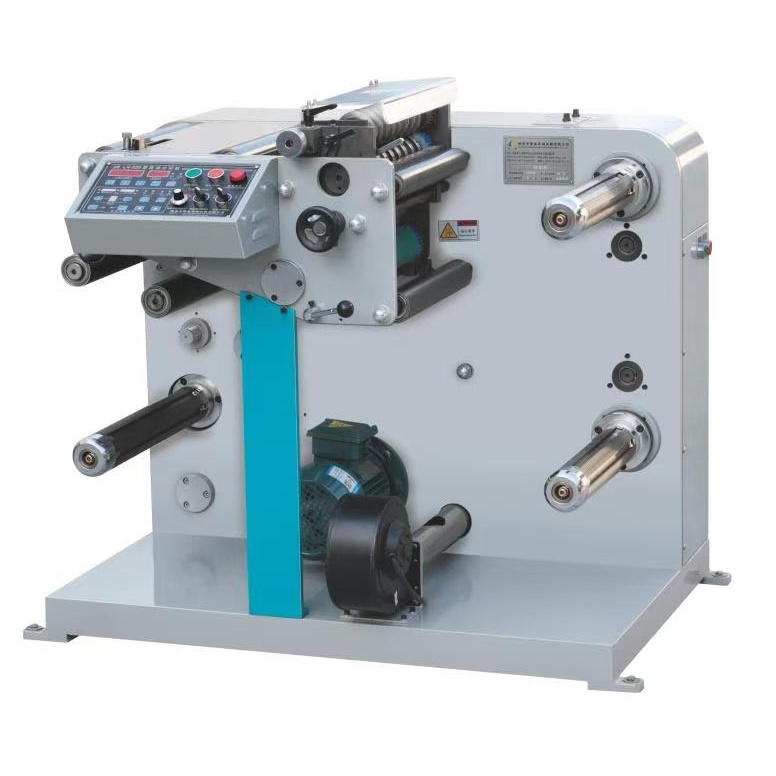
When should you buy automated knife positioning? You must analyze the crossover point. High changeover environments easily justify the premium price. A reliable label slitter rewinder pays for itself through massive labor savings. Automated systems position ten blades in under two minutes. Manual setups take fifteen minutes or more. Manual dovetail tracks work perfectly fine for long runs. Short runs demand automation to stay profitable.
Web Width & Press Compatibility
You must size your equipment properly. Sizing a narrow web slitter involves direct press compatibility. Common industry widths include 13 inches, 17 inches, and 20 inches. Match this directly to your digital press output. Do not buy a 20-inch machine if you only run a 13-inch press. The oversized rollers increase inertia. High inertia makes tension control difficult on narrow webs.
Modularity & Inspection Integration
We recommend evaluating native modularity. Can you easily add an inspection camera later? Missing labels trigger client rejections instantly. 100% print quality inspection prevents defective rolls from shipping. Ensure your machine frame supports future upgrades. Look for pre-drilled mounting plates. Check if the software architecture allows easy camera integration.
4. Implementation Realities and Operational Risks
Floor Space and Workflow
You must choose between inline and offline configurations. This choice heavily impacts bottleneck management. Inline systems connect directly to your digital presses. They save valuable floor space. However, they link your bottlenecks together. If the press stops, finishing stops. Offline setups decouple these processes. You gain significant scheduling flexibility. Operators can finish jobs from multiple presses on one machine. We generally prefer offline setups for short-run agility.
Operator Adoption and Training
Poorly designed human-machine interfaces hide major operational costs. High-turnover labor markets require intuitive screens. Visual guides reduce training time drastically. Operators learn faster when the screen shows clear graphics instead of cryptic codes. Ask vendors to demonstrate their interface. If an operator cannot understand the basic setup within ten minutes, find another vendor. Complexity kills production speed.
Maintenance Dependability
Maintenance dependability keeps your production alive. You must assess the vendor's local parts inventory. Brakes wear out. Pneumatic valves fail eventually. Rotary blades grow dull. Ask vendors about their immediate parts availability. Do they ship overnight? Preventative maintenance routines avoid sudden downtime. We advise creating a strict daily cleaning schedule. Clean the sensors and rollers diligently.
Tension Drift
We must acknowledge the reality of component wear. Tension drift happens over years of heavy use. Brake pads wear down gradually. Air cylinders lose perfect seals. The best machines learn and compensate for this degradation automatically. They use advanced software algorithms. Ask your supplier how their controller handles mechanical aging. Cheap machines require constant manual tweaking as they age.
5. Shortlisting Vendors and Next Steps
The Material Test
You must mandate a physical trial. Never buy equipment based on brochures alone. Send the vendor your most difficult substrate. Include thick adhesives or ultra-thin unsupported films. Require a video of the machine running your specific material. Do this before requesting a final quote. Real-world tests expose hidden equipment flaws. A highly capable label slitting machine handles your worst-case scenario gracefully. If it struggles during the test, it will fail in production.
Vendor Evaluation Checklist
Use a structured approach to evaluate prospective partners. Look beyond the machine specifications. Support infrastructure matters equally.
Lead Times: Verify exact delivery windows. Penalize vendors for vague timelines.
Installation Support: Ask who handles the onsite setup. Factory-trained technicians yield better results than third-party contractors.
SLA Clarity: Define strict response times for technical support. You need guaranteed phone support within hours.
Training Scope: Ensure comprehensive operator training is included in the purchase price.
What to watch out for: Vague warranty terms. Always ask which specific wear parts are excluded from the first-year warranty.
Conclusion
Choosing the right equipment for short-run converting requires a strategic mindset. You must prioritize agility and absolute tension control. Easy operation wins over brute speed every single time. Align the automation level with your expected volume growth. Consider your local labor constraints heavily when choosing software interfaces.
We recommend auditing your current setup waste tomorrow morning. Measure exactly how much material your operators throw away. Contact a converting specialist immediately afterward. Schedule a customized material test using your toughest jobs. Secure your competitive edge by investing in the right technology today.
FAQ
Q: What is the difference between a label slitting machine and a label die-cutter?
A: A slitter focuses on unwinding a master roll, cutting it into narrower lanes continuously, and rewinding it. A die-cutter stamps or cuts specific shapes (like circles or custom contours) into the label web before the matrix is removed.
Q: Can a narrow web slitter handle both paper and synthetic film labels efficiently?
A: Yes, provided it uses shear (rotary) slitting blades and features closed-loop tension control. Films stretch easily, so precise tension management is required. Paper is more forgiving but creates dust, which requires good extraction systems.
Q: How important is an integrated inspection system on a small roll label slitter?
A: It is highly critical for quality assurance. An integrated camera detects missing labels, print defects, and registration errors. It stops the machine automatically, preventing you from shipping defective rolls to your clients.
Q: What causes adhesive bleeding during label roll cutting, and how does the machine prevent it?
A: Bleeding occurs when dull blades squeeze the adhesive layer or winding tension is too high. Proper machines prevent this by utilizing sharp rotary shear blades, cooling the web path, and applying precise, tapered rewind tension.



)